
Digital Storytelling, the creation of multi-media narrative content which is shared digitally, is massively important in the society we live in. Particularly following the COVID-19 pandemic, classrooms, social spheres, industries, and other important aspects of society have in some ways been deeply affected by digitization. For example, many elementary and middle school students work daily with technology in the classroom and at home, completing schoolwork. Thus, it should be apparent how crucial an understanding of Digital Storytelling, its uses, practices, and techniques is for many fields in the contemporary world.
What is it?
According to Bernard Robin’s article, Digital Storytelling: A Powerful Technology Tool for the 21st Century Classroom to Sustainability Science Education, there are seven elements to digital storytelling: Point of View, A Dramatic Question, Emotional Content, Gift of Voice, Power of Soundtrack, Economy, and Pacing. We can consider these aspects as we create a digital story.
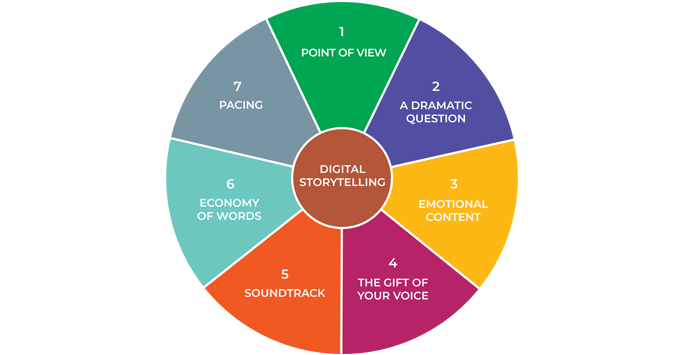
To begin, who am I? What story do I want to tell? Is it to be told from my perspective or another? Then, to engage the audience throughout the piece, posing a dramatic question is necessary. This could be anything from “Will he survive this hike that he should not have taken his sister’s boyfriend on?” to “Will this be the most beautiful trip he’s ever taken?” The question gives a conflict structure to the story, much like that of a fictional novel. By extension, having the narrative be cathartic and emotional allows the viewer to remember and connect with the information being presented in a more meaningful way. The Power of Soundtrack can help immerse the viewer both in the emotional content of the story and also the setting that it takes place in, further engaging the viewer in a more meaningful way. In a similar vein, Gift of Voice, when narration is implemented in the story, can allow the viewer to picture the narrator and know more about them. Economy of Words has much to do with the length of the story, being around eight to ten minutes to maximize engagement and retention of the content of the story. Sometimes being brief and effective with your words can be more important than detail or technical complexity. And finally, understanding when to utilize pacing in relation to the content of the story can greatly enhance the engagement of the viewer. Learning these aspects of the process of Digital Storytelling in this video fundamentally changed my perception of it: it is not a spontaneous leap of faith where the creator throws the proverbial spaghetti at the wall to see if it sticks–but a planned process with careful considerations.
The Power of Digital Storytelling
Digital Storytelling, as the title of Bernard Robin’s article implies, is a powerful classroom tool, but how? In her TEDx talk, Emily Bailin expands on just that. Though I found her introduction a little uncomfortable, the information she discusses is powerful: Digital Storytelling breaks down barriers between educators and students. Within her work as an educator teaching Digital Storytelling to middle schoolers, high schoolers, and undergrads, she’s noticed that Digital Storytelling has created a community of mutual trust within the classroom between her students and her by allowing students to share visuals, art, and writing that is personal to them. Furthermore, oftentimes in the classroom, the educator is seen as the sole authority and voice, but with the collaborative working and sharing process, the relationships become more mutual and less transactional. Finally, Bailin notes that these stories are more powerful with visual and audio elements than simply the written word. I think that this talk highlights the more practical and tangible aspects of Digital Storytelling’s benefits. It reminds me of my old Creative Writing class in seventh grade: I met and got close with so many people of different ways of life and perspectives, but creating as a team may have been the most fun I’ve ever had in a classroom. Furthermore, it reinforces the importance of not just the story being told, but the various means in which it can be delivered.
But what about the outside world?
To Jim Jorstad, the entire world is made up of stories that are waiting to be told. In his TED Talk, he recalls many people and places and the stories he’s uncovered there, from the WW2 photographs taken by his father, to a professor-turned-nun. The important part of this for Jorstad is the inspiration of it all and breaking the barriers that separate us, even in an age where “connection” seems more accessible than ever, to share the stories of real people. I found this talk to be the most powerful because it shifted my perspective on storytelling. What we create does not have to be conclusive, complex, or push the boundaries of what’s possible, but simply powerful and encompassing reality.
How do we do it?
According to Inthecity Studio’s video, the process of Digital Storytelling, as with creating any narrative, is the idea. What story do you want to tell? How do you want to tell it? Depending on your purpose, this also involves tying it into a theme or mission. After that comes research and planning, where you access the information you want to present and create an outline or storyboard to guide the process. Next, guided by the previous steps, you enter production, which, depending on your project, could mean filming, writing, or audio recording, or many at once! Entering post-production, you edit, cut, add music, or do whatever it is you need to represent your vision for the final project. Once it’s ready, you publish, whether on advertisements, social media, email, etc., making sure to target the audience you want to reach. This video, to me, reinforces the importance of planning in the Digital Storytelling process, and within different fields than education, in this case, public action and community work.
By doing this research into Digital Storytelling, I’ve learned a lot that I can use in my own projects moving forward. For one, taking a more stratified approach to planning and creating my digital stories will be something I will account for, as a lot of the videos stressed the importance of preparation and deliberate thought. However, at the same time, spontaneity and inspiration, to me, seem at the core of truly impactful storytelling. What’s the point of meticulously planning how to tell a story when your idea is fundamentally boring? Anyways, I hope you learned something valuable in this blog that you can implement next time you create!