
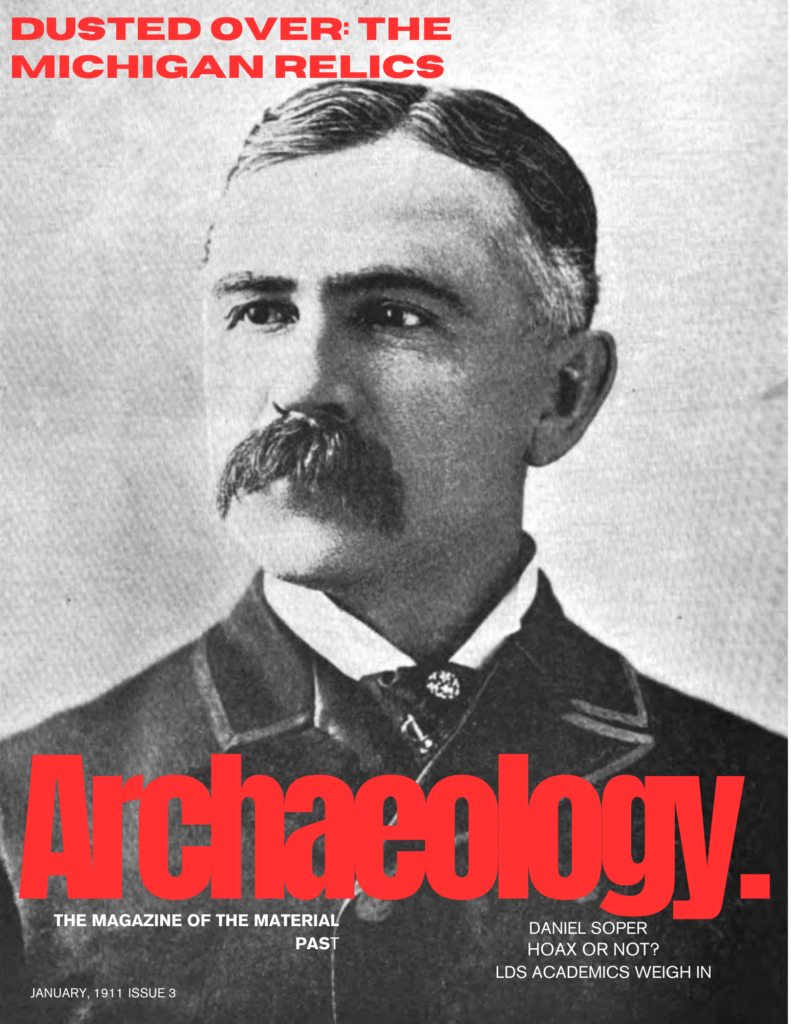
Recently, I was assigned to create an American Archaeology-themed podcast as my final project for a class of the same name. In American Archaeology with Doctor Parker of the UMW Historic Preservation program, we’ve already learned so much, like how the theories and methods of the field have evolved, various theories and sites regarding the settlement of the Americas, and multiple notable archaeologists throughout America’s history. However, what we haven’t touched on yet were the true “characters”, so to speak. That’s right, the crackpots! Thus, when I got together with my group members, and we began digging around, I started as broadly as possible: a simple Wikipedia article with notable American Pseudoarchaeologists.
And there was the name, Daniel Soper, highlighted in blue as an explorable link, a highway into a veritable rabbit hole of crackpot theory. Down, down, I went. Soper was the Secretary of State of Michigan until he resigned amid a scandal in 1890. This prompted him to focus more on his archaeological interests, which manifested in him planting and subsequently “discovering” artifacts at a site in New Mexico, drawing the scrutiny of trained archaeologists. By 1911, Soper and several associates had excavated hundreds of mound sites and unearthed characteristically strange artifacts, the likes of which had never been seen in pre-Columbian America.
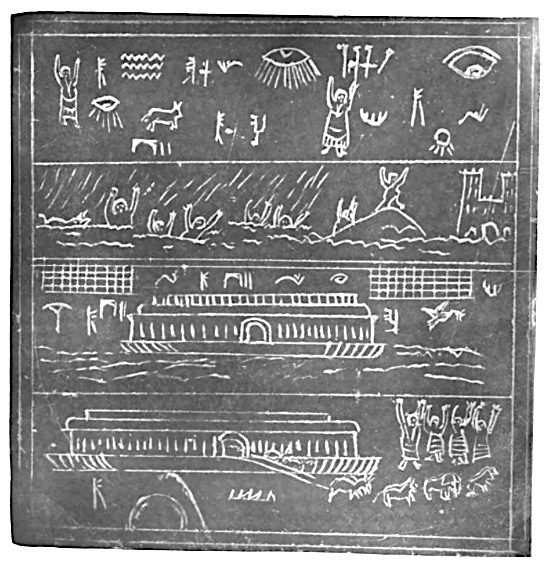
If you look at this image for even a second, you can tell what it was depicting, right? Exactly, you’re correct! Biblical flood, Noah’s Ark, yada yada. Soper and his cronies made hundreds of these tablets and other artifacts to “unearth” at the various “sites” they visited. As pointed out by multiple academic studies, these tablets show no relation to the material culture of different regions in America at the supposed time period, nor were any of them found in poorer condition, NOR were the materials to make them accessible in Michigan. The artifacts, at any point during their existence, have been used as evidence of the Lost Tribe of Israel in Mormon canon, Coptic Christians crossing the Atlantic, and white supremacist theories about America’s ancient origins.
Interestingly enough, one of the largest critics of these relics was a Mormon himself. The first source I chose for this project was written by James Talmage. Talmage was an Englishman, a biologist, and a heavy participant in the Church of the Latter-day Saints. An educated man, Talmage took it upon himself to investigate the hoax as it gained popularity in the early 1900s, particularly within the LDS, as evidence of the idea that the Lost Tribes of Israel had settled the North American continent before ancestral Native Americans, a myth that was the core explanation for the presence of the golden tablets found by Joseph Smith.
Talmage’s 1911 book, The “Michigan Relics”: A Story of Forgery and Deception, is a perfect source for our podcast goals. For one, it includes detailed critiques of Soper and his cronies’ excavations and the artifacts’ supposed origins, but also in-depth primary accounts from Talmage as he was brought along with these men to “uncover” the artifacts at so-called “mound” sites. His accounts reveal that the hoax was simpler than it even appeared to be. Talmage was only allowed to investigate these sites under the eye of Soper’s friend, the digger who excavated all of the artifacts. Eventually, Talmage left Michigan and returned with a professional team without telling any of the hoaxers, excavated the mound sites himself, and found absolutely nothing.
My group members and I are planning on doing a lot of funny voices and sound effects, so our main primary source being English adds just as much to the production as his information does. Anyways, this project is something I’m really looking forward to and perhaps when I’m done I’ll share it all with you. Do you have a favorite archaeological hoax? Please share! Here is the link to this design assignment.